Learning to Live in the In-Between
If you’ve read my previous blogs, you know that I retired early—with a little incentive from the Administration. In June, I wrote about the wisdom of the pause and what I was learning about simply being rather than constantly doing.
September was a bit of a roller coaster as I felt the shift that was coming: moving from accumulation to decumulation. For more than 40 years, I’ve been an income earner. Earning money meant safety, security, and knowing what was coming next. Now I’m learning a different way of accessing money.
It’s uncomfortable, no matter how well you’ve prepared.
Fortunately, I know and trust myself. I didn’t arrive at early retirement by being careless. I know I’m capable of making thoughtful choices, even when they feel unfamiliar. Most days, I’m excited. Some days, making new choices feels uncomfortable—and even a little scary. My motto these days is “Nothing ventured, nothing gained.”
I’ve been challenging myself to step outside my comfort zone: learn something new, experience something different, meet new people, or simply allow myself to be still.
For the first time in a very long time, I can do absolutely nothing—or follow something that brings me sheer joy—without watching the clock for the next item on my list.
I’m learning to let go, enjoy what is, and trust what will be. After all, I’ve been running the same operating system for more than 40 years. Now I’m learning a new one. The rewiring is a little bumpy, but I’m making progress. I've written before about how uncomfortable “being” can feel when you've spent years operating in a culture that rewards constant doing. Learning to find our way home requires us to quiet the external noise long enough to hear ourselves again.
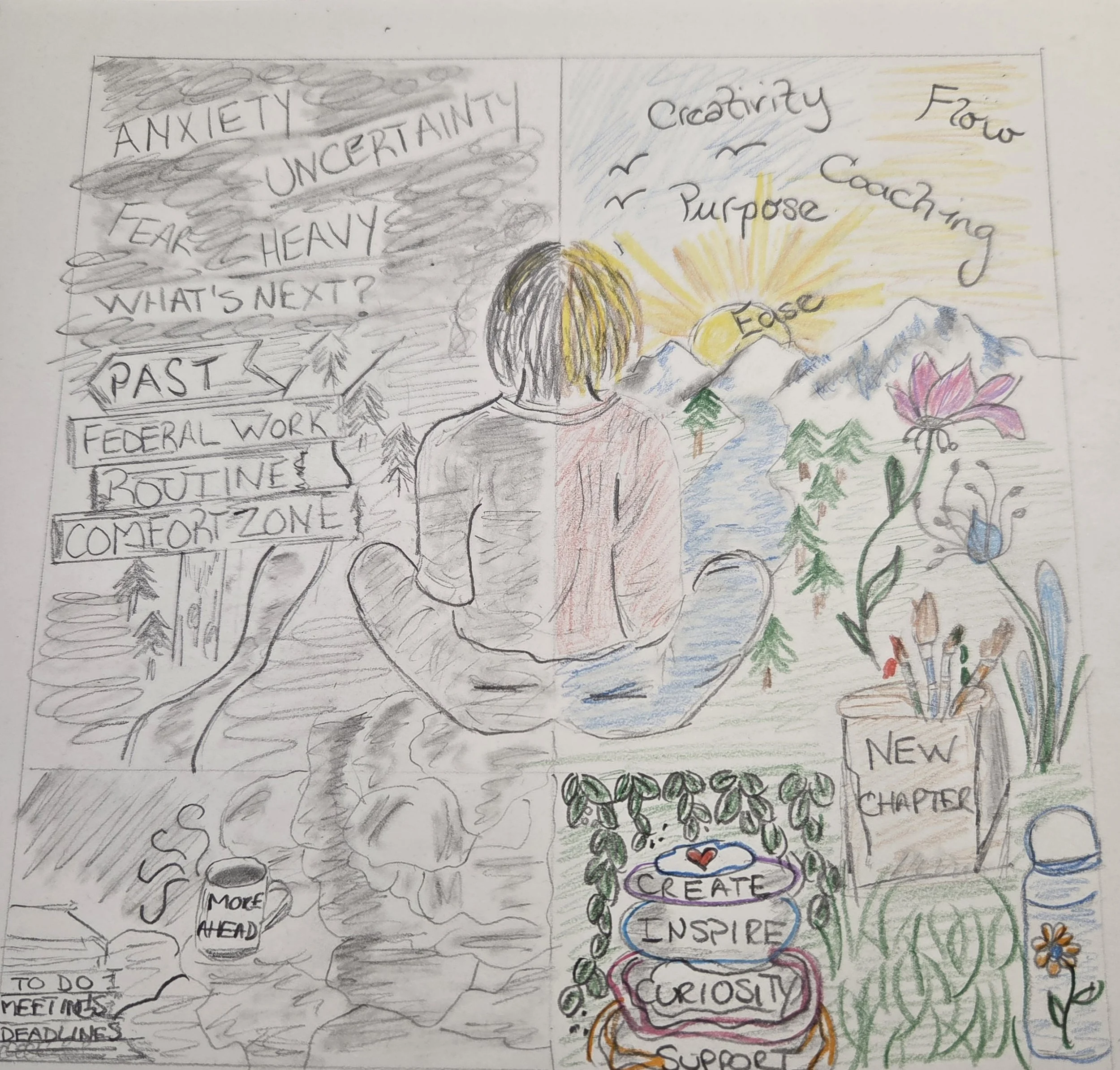
A woman sits between two chapters of her life. Behind her, a black-and-white world represents uncertainty, fear, and the weight of what she has carried. Ahead, color emerges through nature, creativity, and possibility—a visual reflection of learning to let go, trust the unknown, and make room for what’s next.
As a coach, I hold space for my clients rather than trying to manage the outcome. I sit with them in the in-between and normalize the silence—the not knowing, the uncertainty, the absence of easy answers.
These past six months have given me a powerful dose of my own medicine. I’m being reminded that the in-between isn't empty. It’s a place where something new can take root.
This month, I’ve been getting curious about what—and who—I want to be in this next chapter. I decided to volunteer with the International Coaching Federation’s Colorado Chapter, attended my first cacao ceremony, discovered an amazing community of women, and began exploring new creative spaces like Creative Mornings Denver and the Art Garage in Denver.
I’m painting. Drawing. Learning. Meeting people. Following synchronicities. I’m discovering that when I stop trying so hard to figure out what comes next, I create room for a little magic to find me.
Maybe that’s the invitation of the in-between:
Let go of what was.
Trust what is.
Make room for what’s possible.
A little practice for your next in-between
The next time you find yourself between chapters, resist the urge to immediately fill the space.
Instead, get quiet and ask:
What am I being invited to release?
What am I being invited to notice?
What am I curious to explore?
You don't need to answer everything. You don't need a five-year plan. Sometimes the most courageous thing we can do is stay curious in the gap long enough to discover what's trying to emerge. And maybe that's where the real work of transition begins—not in figuring out what's next, but in learning to trust ourselves while we wait for it to reveal itself.
What might become possible if, just for a little while, you stopped trying to figure it all out?
